It’s full speed ahead for the U.S. Navy’s state-of-the-art capability for detecting biological warfare agents onboard and at sea.
Since its initial fielding in 2023, nearly one hundred of the Enhanced Maritime Biological Detection System (EMBD) have been fielded across the fleet,
providing the Navy a “detect to inform” ability to detect, collect and identify airborne biological agents, reducing the risk of ship contamination and minimizing potential casualties.
Acquired and managed by the Joint Program Executive Office for Chemical, Biological, Radiological and Nuclear Defense’s (JPEO-CBRND) Joint Project Manager for CBRN Sensors (JPM CBRN Sensors), the EMBD is a fully automated system that rapidly detects, collects and identifies airborne biological warfare agents that pose a maritime threat to the Navy.
The system is a software and hardware upgrade to the existing Joint Biological Point Detection System (JBPDS) that improves the speed and specificity of biological agent detection by detecting the presence of biological agents in near-real time – within five minutes of exposure, much faster than previous technology. The system also improves the Navy’s readiness to protect Sailors against biological warfare threats by integrating CBRN sensor sub-systems into a single container.
Overall, the capability improves Sailors’ confidence in warning, identification and reporting for biological agents, and reduces life-cycle costs of the Navy’s biological detection systems.
“Just like on land, we are equipped to face CBRN threats in maritime environments and protect our warfighters and assets. Our strong defenses both enhance our protection against these threats and support deterrence,” said Matt Finch, EMBD Program Manager for the U.S. Navy.
EMBD is designed especially for the Navy’s operational environment. Having the ability to rapidly detect and identify BWA while at sea is critical to the fleet, as maritime settings are isolated and confined environments where biological exposures could spread quickly. It’s a ruggedized and isolated system that has been tested against shock and vibration to ensure it can survive in maritime environment – salt, air, water, etc. The system also must be outfitted for ships, a mixed-use environment with lodging, kitchens, engines, communications equipment and more co-located in one space; thus, the EMBD is outfitted to support those various requirements.
EMBD gives Sailors a chance to act quickly through earlier warning and identification. In a scenario when biological agent is suspected, the EMBD evaluates the air quality to detect and identify the biological threat and utilizes GPS to share the geological location of the threat. That information triggers an alarm to alert Sailors and CBRN experts for guidance on next steps for wearing the right protective gear, commencing decontamination efforts, or other measures.
The EMBD is a standalone system that can be networked into the Navy's common operating environment to provide situational awareness and decision support to commanders at the speed of relevance. In the future, EMBD data will be incorporated with the JPEO-CBRND's CBRN command and control system (CSC2) to give commanders enhanced decision dominance across all domains.
Over the past years of fielding, the team received important user feedback and learned to refine their fielding process and develop more efficient training techniques that decreased system installation and testing from five to three days.
EMBD is on track to achieve full operational capability within the next two years.
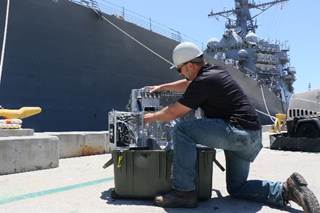
Since its initial fielding in 2023, nearly one hundred Enhanced Maritime Biological Detection Systems have been fielded across the fleet. (Credit: U.S. Navy)
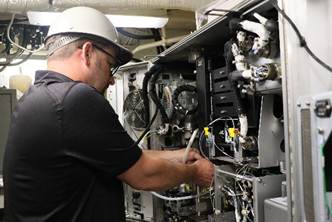
The EMBD provides the Navy a “detect to inform” ability to detect, collect and identify airborne biological agents that reduces the risk of ship contamination and minimizes potential casualties. (Credit: U.S. Navy)