Countering Emerging Threats - Rapid Acquisition and Investigation of Drugs for Repurposing (CET RAIDR)

Joint Enterprise Technology Tool (JETT)

JETT-Joint-Enterprise-Technology-Tool logo

Do you have an idea or technology that could help protect our warfighters from CBRN threats? Connect with the CPE CBRND through the Joint Enterprise Technology Tool (JETT).

Joint Enterprise Technology Tool

Contracting Overview

CPE CBRND's mission to provide integrated layered chemical, biological, radiological, and nuclear (CBRN) defense is made possible by our industry partners, who play a vital role in supporting the Joint Force.

JPEO-CBRND Partnering Vehicles

Contracting Focus Area

Multiple Award Task Order Contract (MATOC)

MATOCs promote competition, save costs, encourage small business participation, minimize time to award, and streamline documentation. The CPE CBRND Contracting Office manages MATOCs. Click below for opportunities in each contract area.

Downloads

Other Transactions Agreements (OTA)

OTAs enable the Department of War (DoW) to access technologies from non-traditional partners. The CPE CBRND Contracting Office manages OTAs. Click below for opportunities in each OTA contract area.

Links

Alternative Contracts

Stand-Alone Contracts

No "one size fits all" model exists for CBRND product development and production. Each collaboration is as unique as the product. Vehicle selection considerations range from acquisition history, requirement urgency, requirement complexity, and other factors.

Learn more about stand-alone contracts through the CPE CBRND Contracting Office and General Services Administration's SAM.gov

Joint Project Manager (JPM) CBRN Medical TechWatch

JPM CBRN Medical plays a vital role in enhancing the DoW’s strategy to prevent, diagnose, and treat the effects of CBRN threats and emerging infectious diseases.

Opportunities through the public-private partnership TechWatch help JPM CBRN Medical develop and acquire safe, effective, and innovative medical solutions and systems to combat CBRN and other emerging infectious diseases.

The Joint Project Manager for Chemical, Biological, Radiological, and Nuclear Medical (JPM CBRN Medical) aims to provide U.S. military forces and the Nation with safe, effective, and innovative medical solutions to counter chemical, biological, radiological, and nuclear (CBRN) threats. The JPM CBRN Medical facilitates the advanced development and acquisition of medical countermeasures (MCM) and systems to enhance the Nation’s biodefense response capability.


Overview

The mission of the CET RAIDR program is to provide the U.S. military forces and the Nation with safe, effective, and affordable prophylactic and therapeutic solutions to counter traditional, emerging, and engineered/synthesized biological and chemical threats. The CET RAIDR program is based on an Office of the Secretary of Defense (OSD)-directed requirement, indicating that repurposing will be an integral pillar for future MCM development. From a strategic perspective of national preparedness, RAIDR supports the realization the 2021 American Pandemic Preparedness Plan: Transforming Our Capabilities. Additionally, the 2022 National Biodefense Strategy and Implementation Plan calls for repurposed therapeutics within reach for pandemic preparedness and national security. This cannot be achieved without considering appropriate, relevant, repurposing of available pharmaceuticals. This 2022 plan directs stakeholders to “identify, develop, test, authorize, manufacture, and deploy new and repurposed therapeutics”. This goal synergistically maps to the CET RAIDR programs mission space.
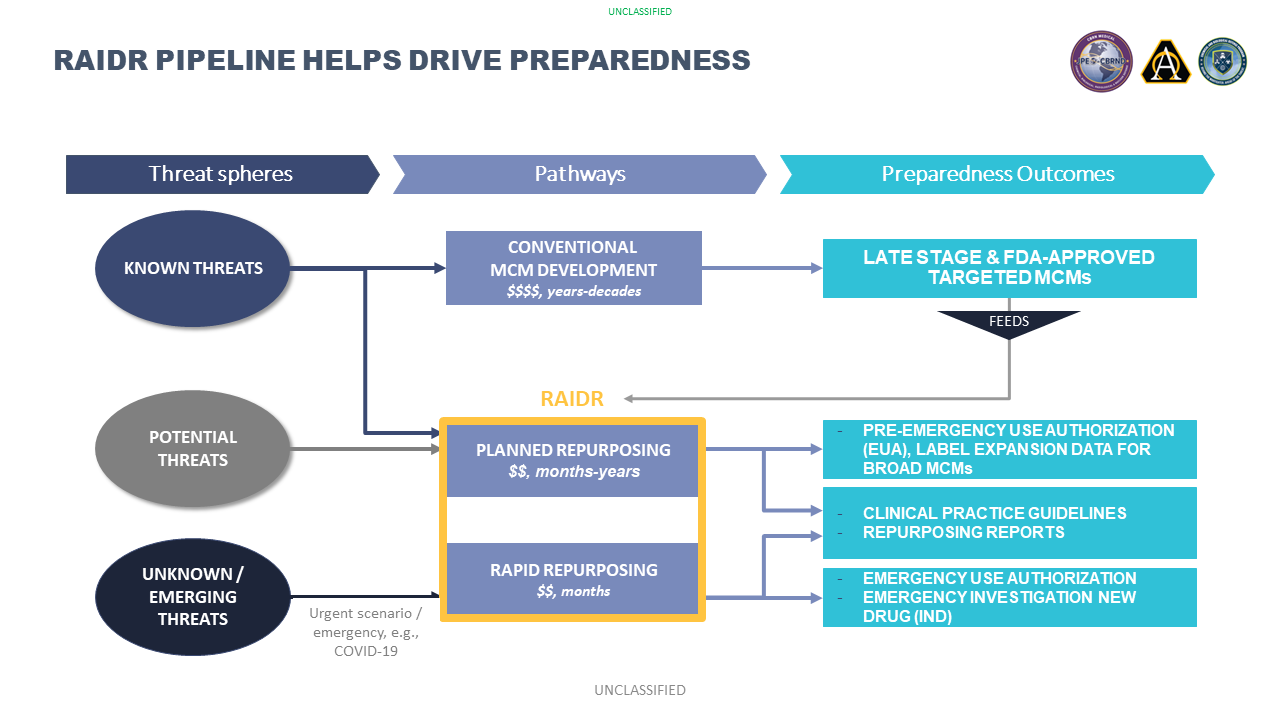
RAIDR Pipeline Helps Drive Preparedness (CLICK TO ENLARGE)The impact of CET RAIDR is illustrated by the partnership with Rigel Pharmaceuticals to repurpose TAVALISSE (fostamatinib), posturing this product for the potential use in the treatment of acute respiratory distress syndrome (ARDS) associated with COVID-19. This partnership demonstrates the utility of repurposing FDA-approved countermeasures to rapidly address medical capability gaps in support of the warfighter.

CET RAIDR’s vision is to consistently contribute to a sustained MCM pipeline through repurposing.

Prioritization of CET RAIDR efforts is guided by the following:
• Level of threat risk and unmet needs
• Evidence for Mechanism of Action (MOA)/target knowledge
• Available partnerships
• Balance with existing portfolio
• Available Science and Technology (S&T) Tools (e.g., animal models, existing assets)

The objective of the CET RAIDR program will be to produce a minimum of two repurposing target outcomes per year. Candidates for the CET RAIDR program are already proven to be safe and manufacturable medicines, and are viable for accelerated delivery of a safe and effective product, compared to the conventional drug development pathways.

Repurposing outcomes include:
• Repurposing Reports
• Clinical Practice Guidelines (CPGs)
• Pre-positioning of candidates for emergency-Investigational New Drugs (INDs)
• Pre-positioning of candidates for Emergency Use Authorizations (EUA)

JPEO-CBRND Report Cover
The CET RAIDR program is focused on delivering interim capabilities by rapidly addressing patient symptoms, even when a clearly defined diagnosis is unavailable. This will assist with the military’s ability to respond to a range of threats quickly in an operational or deployed setting; it is referred to as a “syndromic approach.” By repurposing medicines that have broad-acting applications, this program equips the warfighter with a multifaceted set of drugs that could prolong life and/or extend time-to-treat for a wider range of possible threats. These repurposing efforts provide medical care to the warfighter while targeted medical countermeasures are transiting the conventional MCM development process. These efforts may also identify medical countermeasures that have potential for label expansion.

"Preparedness, particularly for known unknowns like novel viruses, starts with people and partnerships. Our CET RAIDR effort brings in partnerships with academia and industry, resulting in deliveries that build a bridge to existing capabilities and maximize readiness for those we serve."

Colonel Matthew G. Clark
Joint Project Manager for the Chemical, Biological, Radiological, and Nuclear Medical